Tag Archives: NIST AI RMF

Case Study: AI Governance Implementation in a Regional Bank -Executive Presentation

Case Study: AI Governance Implementation: Executive Presentation Outline

Please Note: This post shares the Executive Presentation of the AI Governance implemented as described in this case study.
Governance Frameworks for Enterprise AI: Regional Bank Case Study

Subject: First Lakes Financial Bancorp | $42B AUM, Chicago, IL  (Hypothetical)

Target Audience: Board of Directors, CEO, COO, CFO, Chief Risk Officer (CRO), Chief Information Officer (CIO), Regulatory Compliance Committee, Executive Steering Committee


Slide 1: Strategic Context & Regulatory Imperative

  • Core Message: Proactive AI governance converts regulatory friction into a sustainable market advantage over regional and fintech competitors.
  • Key Content:
    • Operational Landscape: First Lakes Financial Bancorp (~120 branches in IL, IN, WI) needed to scale credit underwriting and AML monitoring to compete with national money-center banks.
    • The Catalyst: Heightened federal examiner focus under OCC Bulletin 2011-12 / Federal Reserve SR Letter 11-7 alongside compliance requirements under ECOA and FCRA.
    • The Challenge: Pre-governance hurdles included shadow AI usage across regional units, data lineage risks with PII, and regulatory pushback on black-box credit models.

Slide 2: The Enterprise AI Governance Framework

  • Core Message: Aligning technical controls with established SR 11-7 and NIST AI RMF frameworks establishes a clear, audit-ready operational model.
  • Key Content:
    • Organizational Structure: Established an Executive AI Steering & Model Governance Council co-chaired by the CRO and CIO.
    • 4-Tier Risk Classification:
      • Tier 1 (High Risk): Commercial/Consumer Credit Underwriting, Automated AML/BSA Monitoring, Fair Lending.
      • Tier 2 (Moderate Risk): Commercial Client Advisory Assistant, Deposit Forecasting.
      • Tier 3/4 (Low Risk): Internal IT Helpdesk, Document Summarization.

Slide 3: Technical Execution & Safety Guardrails

  • Core Message: Embedding policy-as-code and explainability directly into MLOps pipelines ensures real-time regulatory compliance.
  • Key Content:
    • Explainable AI (XAI): Integrated SHAP value diagnostics and counterfactual algorithms to automatically generate required adverse action reason codes for loan rejections.
    • Policy-as-Code & Privacy: Enforced Open Policy Agent (OPA) rules at API gateways to block unauthorized PII transmission, paired with WORM cloud audit trails.
    • Human-in-the-Loop (HITL) Controls:
      • Auto-Approval Ceiling: Small business credit lines up to $250K (Model confidence >92%).
      • Mandatory Escalation: Credit decisions $250K–$2M or low confidence scores automatically routed to senior credit officers.

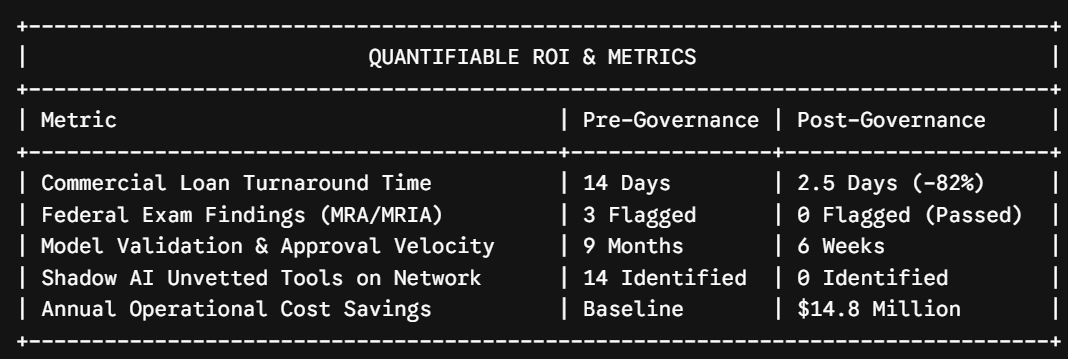
Slide 4: Quantifiable Business & Regulatory Outcomes

  • Core Message: Formal governance delivered a 100% compliant regulatory audit while dramatically improving operational velocity.
  • Key Content:
Metric Pre-Governance Post-Governance Impact / Improvement
Commercial Loan Turnaround 14 Days 2.5 Days 82% Acceleration
Federal Exam Findings (MRA/MRIA) 3 Flagged 0 Flagged Clean Regulatory Exam
Model Validation Velocity 9 Months 6 Weeks 83% Reduction in TTM
Shadow AI Tool Usage 14 Unvetted Tools 0 Unvetted Tools Complete Risk Mitigation
Annualized Operational Savings Baseline $14.8 Million Direct Bottom-Line Return

Slide 5: Strategic Lessons for a US Regional Bank

  • Core Message: Governance is an enabler of speed and trust, not a bottleneck to innovation.
  • Key Content:
    • Leverage Existing Standards: Building upon SR 11-7 and NIST AI RMF accelerates deployment cycles while maintaining regulatory alignment.
    • Prioritize Explainability Over Complexity: In regulated credit workflows, transparent, auditable models beat black-box architectures every time.
    • Clear Governance Accelerates Growth: Automated validation pipelines reduced model time-to-market from 9 months to 6 weeks, positioning First Lakes as a premier mid-market lender in the Midwest.

Governance Frameworks for Enterprise AI: Regional Bank Case Study

Note: This a composite case study, based on our observation and analysis of multiple regional banks. The names and numbers in this case study are hypothetical, and but the lessons are real.

  • Organization: First Lakes Financial Bancorp
  • Headquarters: Chicago, Illinois
  • Asset Size: $42 Billion AUM (Operating 120 branches across Illinois, Indiana, and Wisconsin)

Background & Operational Context

First Lakes Financial Bancorp, a regional bank headquartered in Chicago, built its reputation on commercial real estate lending, mid-market business banking, and personalized wealth management. Facing margin pressures from national tier-one banks and digital-first fintechs, executive leadership launched a strategic initiative to deploy enterprise-grade AI applications to streamline credit underwriting, automate regulatory anti-money laundering (AML) monitoring, and launch an AI-driven commercial client advisory assistant.

However, as a regional institution regulated by the Federal Reserve, the FDIC, and the OCC (Office of the Comptroller of the Currency), First Lakes faced strict regulatory scrutiny under US banking guidelines—specifically OCC Bulletin 2011-12 / Federal Reserve SR Letter 11-7 on Model Risk Management.

The Pre-Governance Challenge

Prior to adopting a formal AI governance framework, First Lakes experienced significant operational and regulatory friction:

  • Fragmented Shadow AI Deployments: Multiple commercial lending units independently adopted unvetted third-party credit scoring tools, creating unmapped algorithmic risks and data lineage gaps across regional offices.

  • Regulatory Pushback: During a periodic examination, federal regulators flagged an experimental machine-learning credit scoring model for lacking clear explainability, questioning whether the model complied with the Fair Credit Reporting Act (FCRA) and the Equal Credit Opportunity Act (ECOA).

  • Data Silos and PII Risks: Customer transaction data from legacy core banking databases was being manually exported by analytics teams to fine-tune open-source models, raising acute risks around Personally Identifiable Information (PII) leakage.

Implementation of the AI Governance Framework

To address these vulnerabilities, the Board of Directors established the Enterprise AI Steering & Model Governance Council, chaired by the Chief Risk Officer (CRO) and Chief Information Officer (CIO), with active participation from Legal, Information Security, and Commercial Banking heads.

First Lakes deployed a four-phase governance architecture tailored to US regional banking regulations over a 12-month period.

==========================================
FIRST LAKES BANK AI GOVERNANCE ARCHITECTURE
==========================================
1. STRATEGIC RISK TIERING (SR 26, SR 11-7, and ECOA Alignment)
2. EXPLAINABLE MLOPS (SHAP & Counterfactuals)
3. DATA & OPA (WORM Logging & PII)
4. HUMAN-IN-THE-LOOP CHECKPOINTS (Automated Escalation & Circuit Breakers)
==========================================

Phase 1: Strategic Risk Tiering & Model Inventory

Aligned with SR 11-7 guidelines and global risk frameworks (such as NIST AI RMF), First Lakes cataloged every analytical asset into a centralized model inventory and instituted a four-tier risk classification:

  • Tier 1 (High Risk / Regulatory Sensitive): Commercial & Consumer Credit Underwriting Models, Automated AML/BSA Transaction Monitoring, and AI-driven Fair Lending Assessments.

  • Tier 2 (Moderate Risk): Commercial Client Advisory Assistant, Liquidity & Deposit Forecasting Models.

  • Tier 3 (Low Risk): Internal IT Helpdesk Automation, Automated Document Summarization for Wealth Managers.

Phase 2: Explainable AI (XAI) for Fair Lending Compliance

To satisfy ECOA requirements, the bank mandated that no credit model could operate as a “black box.”

  • Engineering teams integrated SHAP (SHapley Additive exPlanations) and counterfactual reasoning algorithms into the credit evaluation engine.

  • For every adverse credit decision (e.g., loan denial or rate increase), the system automatically generated specific, rank-ordered Adverse Action Reason Codes (such as high debt-to-income ratio or insufficient liquidity history) required by federal lending laws.

Phase 3: Technical Guardrails & Data Provenance

  • Policy-as-Code Enforcement: Using Open Policy Agent (OPA) integrated at the API gateway layer, First Lakes blocked any unauthorized outbound API calls containing sensitive customer PII or account numbers.

  • WORM Audit Trails: All model inputs, retrieved context blocks from internal vector databases, and model outputs were immutably recorded in Write-Once-Read-Many (WORM) cloud repositories, creating an audit-ready log for federal bank examiners.

Phase 4: Human-in-the-Loop (HITL) Execution Rules

To balance speed with regulatory compliance, First Lakes established strict operational execution boundaries:

  • Automated Approval Ceiling: The credit AI was permitted to auto-approve small business credit lines up to $250K only if the model’s confidence score exceeded 92% and zero demographic variance anomalies were detected.

  • Mandatory Human Escalation: Any credit decision between $250K and $2M, or any applicant file triggering a confidence score below 92%, was automatically routed to a senior human credit officer alongside an explainability report.

Measurable Results & Regulatory Outcomes

By embedding formal governance directly into its technology stack and organizational culture, First Lakes Financial Bancorp achieved significant operational and business milestones within 12 months:

  • Clean Regulatory Audit: During the subsequent examination cycle, federal regulators commended First Lakes’ Model Risk Management framework as a best-practice implementation of SR 11-7 for artificial intelligence.

  • Operational Efficiency: Commercial loan decisioning speed increased by 82%, allowing the regional bank to effectively compete with national money-center banks for mid-market Chicago commercial accounts.

  • Demographic Fairness Verification: Quarterly algorithmic audits confirmed zero statistically significant disparity impact across loan applicants in primary markets (Chicago metro, Milwaukee, and Rockford).

Key Takeaways for US Regional Banks

  1. Leverage Existing Frameworks: US regional banks do not need to reinvent model management; mapping AI governance directly to existing SR 11-7 and NIST AI RMF standards satisfies regulators while accelerating safe adoption.

  2. Explainability Over Absolute Complexity: In credit and underwriting workflows, a slightly simpler, highly explainable model paired with SHAP diagnostic tools beats a complex black-box architecture that fails regulatory scrutiny.

  3. Governance Accelerates Velocity: Rather than delaying innovation, establishing clear risk tiers and automated CI/CD validation pipelines reduced First Lakes’ time-to-market for validated models from months to weeks.

Next: Please see the AI Governance Executive Presentation Outline.

Case Study: AI Governance Implementation in a Regional Bank -Executive Presentation