Category Archives: Regional Banks

Enterprise Risk Management Audit (ERMA)

Institutional Resilience Assessment for Banks and Financial Institutions- by BFSI Strategy

Can your institution carry risk successfully enough to deserve the trust placed in it?

Banks and financial institutions are paid to carry risks that their customers, depositors, investors, counterparties, and communities cannot or do not wish to carry themselves.

  • Credit risk.
  • Liquidity risk.
  • Interest-rate risk.
  • Market risk.
  • Operational risk.
  • Cyber risk.
  • Technology risk.
  • Third-party risk.
  • Fraud risk.
  • Regulatory risk.
  • Strategic risk.
  • And increasingly, AI-related risk.

Accepting risk is not an unfortunate consequence of banking and financial services.

Accepting and carrying risk successfully is one of the fundamental purposes of banking and financial services.

The real test of a financial institution is not whether risk exists.

Risk will always exist. The real test is whether the institution can continue functioning when those risks materialize—sometimes unexpectedly, sometimes simultaneously, and sometimes under severe economic or operational stress.

That is the purpose of the Enterprise Risk Management Audit (ERMA) from BFSI Strategy.

ERMA is an Institutional Resilience Assessment designed to examine whether a bank or financial institution possesses the financial capacity, operational resilience, governance, technology, cybersecurity, risk-management capability, and leadership architecture necessary to carry the risks entrusted to it.

The central question is simple but critical:

Can this institution carry risk successfully enough to deserve the trust placed in it?

Everything in the ERMA engagement is ultimately directed toward answering that question.


Why an Enterprise Risk Management Audit?

Most financial institutions already have extensive risk-management infrastructure. They have policies. They have dedicated teams.

Risk committees. Risk registers. Limits. Dashboards.

Internal controls. Compliance programs. Business continuity plans.

Cybersecurity systems.  Incident-response plans.

Audit programs. Stress tests. Capital plans. Liquidity plans.

Vendor-risk processes. AI governance initiatives.

And hundreds—sometimes thousands— of risk indicators.

Yet the existence of these mechanisms does not automatically mean the institution is resilient.

  • A policy can exist and fail.
  • A control can exist and be bypassed.
  • A limit can exist and be overridden.
  • A recovery plan can exist and not work.
  • A backup can exist and still be unrecoverable.
  • A cyber defense can exist while an attacker possesses privileged access.
  • A liquidity plan can exist while its underlying assumptions are unrealistic.
  • An AI governance framework can exist while unauthorized AI usage remains widespread.
  • A board can receive hundreds of pages of risk information while still failing to see the one vulnerability capable of causing severe institutional damage.

That is why BFSI Strategy does not begin ERMA by asking:

“Does the bank have a control?”

We ask:

“Can the bank demonstrate that the control will protect the institution when it matters?”

Or, in simpler language:

“We do not ask whether the door has a lock. We ask who else has the keys.”

ERMA is therefore designed to move beyond control existence toward control effectiveness. Beyond policy toward evidence.

Beyond compliance toward resilience. Beyond individual risk categories toward the institution as a whole.


The Purpose: Institutional Resilience

ERMA is not intended to be another routine checklist exercise.

Its purpose is to examine the institution’s ability to absorb shocks, continue critical operations, protect customers, make decisions under pressure, recover from disruption, and preserve confidence.

We define Institutional Resilience as the ability of a financial institution to:

  • Anticipate significant risks.
  • Absorb financial and operational shocks.
  • Continue delivering critical services.
  • Protect customers, assets, information, and infrastructure.
  • Make effective decisions under uncertainty.
  • Contain failures before they spread.
  • Recover rapidly from disruption.
  • Learn from adverse events.
  • Adapt to changing threats and market conditions.
  • Preserve stakeholder trust through periods of stress.

Institutional resilience therefore sits above any single risk discipline. It is the combined outcome of how the institution manages all of them.


ERMA Looks at the Bank or Financial Institution as One Risk-Bearing System

Banks typically organize risks into separate categories.

  • Credit risk may sit within one function.
  • Liquidity within another.
  • Cybersecurity within technology.
  • Operational risk within risk management.
  • AI governance within technology or innovation.
  • Third-party risk within procurement or risk.
  • Business continuity within operations.
  • Strategic transformation within another executive function entirely.

This specialization is necessary. But real crises do not respect organizational structures.

For example, a geopolitical event can create:

  • Market volatility.
  • Sanctions exposure.
  • Cyber threats.
  • Commodity-price shocks.
  • Customer stress.
  • Credit deterioration.
  • Liquidity concerns.
  • Payment disruption.
  • Operational pressure.
  • And reputational risk.

All at the same time.

Similarly, a cyber incident can become:

  • An operational crisis.
  • A customer-service crisis.
  • A liquidity issue.
  • A regulatory issue.
  • A reputational issue.
  • A legal issue.
  • And potentially a strategic issue.

ERMA therefore evaluates not merely individual risks but also the connections between them.

One of the key questions is:

What happens when several things go wrong at the same time?

That question often reveals vulnerabilities that conventional risk assessments miss.


The ERMA Assessment Framework

BFSI Strategy’s Enterprise Risk Management Audit examines ten major dimensions of institutional resilience.


1. Enterprise Risk Architecture

We begin by examining whether the institution has a coherent understanding of the risks it is carrying.

Key areas include:

  • Enterprise risk taxonomy
  • Material risk identification
  • Emerging risk identification
  • Risk appetite
  • Risk limits
  • Risk ownership
  • Risk concentrations
  • Correlated risks
  • Escalation thresholds
  • Enterprise risk reporting

We ask whether management truly understands the institution’s major vulnerabilities or whether important risks remain fragmented across departments.


2. Board and Executive Risk Governance

Risk management ultimately depends upon decision-making.

ERMA examines whether the board and executive leadership receive the right information, ask the right questions, challenge assumptions, and act when necessary.

We assess areas including:

  • Board risk oversight
  • Executive accountability
  • CRO authority
  • Independence of challenge
  • Risk committee effectiveness
  • Escalation mechanisms
  • Exception governance
  • Decision rights
  • Management information
  • Board risk reporting

A governance system should not merely demonstrate that committees met. It should demonstrate that better decisions were made because governance existed.


3. Capital, Liquidity and Balance-Sheet Resilience

Financial resilience remains fundamental. ERMA examines the institution’s capacity to absorb financial shocks while continuing to meet its obligations.

Areas may include:

  • Capital adequacy
  • Liquidity resilience
  • Funding concentration
  • Deposit behavior
  • Contingency funding
  • Interest-rate exposure
  • Asset-liability management
  • Market liquidity
  • Collateral availability
  • Stress assumptions

The objective is not simply to confirm the existence of ratios and plans. It is to determine whether the balance sheet remains resilient when conditions become materially worse than expected.


4. Credit and Concentration Risk

Credit losses rarely appear without warning.

The question is whether the institution recognizes deterioration early enough and whether concentrations are understood before they become dangerous.

ERMA evaluates:

  • Underwriting standards
  • Portfolio quality
  • Sector concentrations
  • Geographic concentrations
  • Counterparty exposures
  • Collateral assumptions
  • Refinancing risk
  • Early-warning indicators
  • Problem-loan governance
  • Credit exceptions

We also examine hidden or invisible concentrations.

For example, 25 different borrowers may still represent one underlying economic risk if they all depend upon the same industry, region, funding environment, commodity, or property market.


5. Operational Resilience and Business Continuity

A financial institution exists through the services it provides.

Customers do not experience an organization chart.

They experience whether:

  • Their money is accessible.
  • Payments work.
  • Cards function.
  • Deposits arrive.
  • Transactions settle.
  • Customer service responds.
  • Businesses can make payroll.
  • Critical financial services remain available.

ERMA identifies the institution’s most important business services and examines whether they can continue through severe disruption.

Areas include:

  • Critical business services
  • Impact tolerances
  • Business continuity
  • Disaster recovery
  • Operational dependencies
  • Manual workarounds
  • Recovery capabilities
  • Key-person dependency
  • Facilities resilience
  • Crisis operations

6. Cybersecurity and Digital Resilience

Cybersecurity is no longer simply an IT issue.  A serious cyberattack can rapidly become an enterprise crisis.

ERMA examines whether the institution can prevent, detect, contain, respond to, and recover from cyber incidents.

Areas include:

  • Identity and access management
  • Privileged access
  • Multi-factor authentication
  • Network segmentation
  • Endpoint protection
  • Vulnerability management
  • Patch management
  • Logging and monitoring
  • Incident response
  • Backup integrity
  • Recovery testing
  • Ransomware preparedness
  • Third-party cyber exposure
  • Security governance

A core ERMA question is:

If an attacker crosses the first defensive layer, what stops them next?


7. Technology, AI and Transformation Risk

Modern banks are simultaneously operating legacy infrastructure while adopting cloud platforms, artificial intelligence, automation, digital banking, new payment systems, and data technologies.

Transformation itself therefore becomes a source of risk.

ERMA evaluates:

  • Legacy technology exposure
  • Core-system dependencies
  • Technology concentration
  • Cloud architecture
  • Data governance
  • AI inventory
  • AI governance
  • Model accountability
  • Human oversight
  • Transformation dependencies
  • Change-management risk
  • Major technology migrations
  • Program governance

We ask whether transformation is making the institution simpler and more resilient—or merely adding another layer of complexity.


8. Third-Party and Supply-Chain Risk

Modern banking depends heavily on external providers.

Cloud platforms.

Payment processors.

Telecommunications providers.

Software vendors.

Cybersecurity companies.

AI providers.

Data providers.

Fintech partners.

Outsourcing firms.

A strong supplier can still represent a dangerous concentration.

ERMA examines:

  • Critical vendors
  • Vendor concentration
  • Fourth-party dependencies
  • Cloud concentration
  • Contractual protections
  • Exit planning
  • Data portability
  • Switching capability
  • Continuity arrangements
  • Vendor incident response

One of the questions we ask is:

What happens to the institution if this provider simply disappears tomorrow?


9. Crisis Management and Recovery

Risk management must work when normal management conditions disappear.

  • During a crisis, information may be incomplete.
  • Conflicting reports may arrive simultaneously.
  • Customers may become concerned.
  • Regulators may require immediate answers.
  • Markets may move very far away from your baseline scenario.
  • Technology may be unavailable.
  • Executives may have minutes — not days— to decide.

ERMA examines:

  • Crisis governance
  • Decision authority
  • Command structures
  • Information management
  • Escalation
  • Regulatory communication
  • Customer communication
  • Board involvement
  • Scenario exercises
  • Recovery leadership
  • Post-incident learning

The audit seeks to find whether leadership can create clarity when the institution is surrounded by noise.


10. Risk Culture and Organizational Capability

Risk management is carried out by people. Organizational culture determines whether problems are raised or hidden. Whether assumptions are challenged. Whether controls are respected.  Whether exceptions become normalized. Whether bad news reaches senior leadership quickly.

ERMA therefore considers:

  • Risk ownership
  • Challenge culture
  • Incentives
  • Escalation behavior
  • Management response to bad news
  • Near-miss reporting
  • Accountability
  • Learning culture
  • Risk capability
  • Executive risk literacy

A bank may possess excellent systems and still remain vulnerable if employees believe that speaking up creates career risk.


The 50-Question Institutional Resilience Diagnostic

At the heart of ERMA is a structured diagnostic covering 50 core institutional resilience questions across the areas above. These questions are not designed simply to generate yes-or-no responses. Each question is examined through multiple layers of evidence.

For example:  Instead of asking:

“Does the bank have an incident-response plan?”

ERMA asks:

“When was the plan last tested under realistic conditions, what failed during the exercise, what corrective actions were taken, and can management demonstrate that those weaknesses have been resolved?”

Instead of asking:

“Does the bank maintain backups?”

ERMA asks:

“Can the institution demonstrate successful recovery of critical services if production infrastructure and normal online backups are simultaneously compromised?”

Instead of asking:

“Does the bank have an AI policy?”

ERMA asks:

“Can management identify every material AI use case, explain what information enters those systems, identify who is accountable, demonstrate appropriate controls, and explain what happens if the model produces a materially incorrect output?”

The difference is fundamental.


Five Layers of Evidence

ERMA evaluates important risks and controls across five evidence dimensions.

1. Policy

What does the institution say should happen?

Policies establish expectations, responsibilities, standards, and boundaries. But policy alone is insufficient.


2. Ownership

Who is responsible?

Every material risk and control should ultimately have accountable leadership. Ambiguous ownership creates unmanaged risk.


3. Implementation

What actually happens in daily operations?

A formally approved process may differ significantly from operational reality. ERMA looks for those gaps.


4. Testing

Has the capability been tested?

The institution should demonstrate that important controls function when challenged.

Examples may include:

  • Recovery exercises
  • Cyber simulations
  • Liquidity scenarios
  • Crisis exercises
  • Control testing
  • Model validation
  • Vendor-failure scenarios

5. Outcomes

Did the control actually reduce risk?

The strongest evidence is not that a process occurred. It is that the process produced the intended protective outcome.


We Test the Control, the Bypass and the Failure Mode

One of the defining principles of the BFSI Strategy methodology is that every important control should be examined from three perspectives.

The Control

What is supposed to protect the institution?

The Bypass

How could the control be circumvented, overridden, compromised, or ignored?

The Failure Mode

What happens to the institution when that control fails?

This principle is captured by one simple question:

“We do not ask whether the door has a lock. We ask who else has the keys.”

  • A bank may have MFA. But who can bypass it?
  • A bank may have lending limits. But who can approve exceptions?
  • A bank may segregate duties. But who has administrator privileges capable of overriding those controls?
  • A bank may maintain backups. But can attackers delete them?
  • A bank may have risk limits. But how often are they temporarily waived?
  • A bank may prohibit sensitive information from entering public AI systems. But can employees still do it?

These questions reveal the difference between control architecture and actual protection.


Scenario-Based Testing

ERMA does not assume risks occur independently. Where appropriate, BFSI Strategy considers combined scenarios such as:

Scenario 1: Liquidity + Confidence Shock

A major negative event causes concentrated deposit withdrawals while market funding conditions deteriorate.

Scenario 2: Cyberattack + Operational Disruption

A cyber incident compromises privileged credentials and affects critical banking services.

Scenario 3: Credit + Refinancing Stress

Borrowers simultaneously face higher refinancing costs and declining collateral values.

Scenario 4: Third-Party + Technology Failure

A critical external provider fails during a major internal transformation.

Scenario 5: AI + Fraud Event

AI-enabled impersonation or fraud bypasses conventional controls at significant scale.

Scenario 6: Geopolitical + Sanctions + Cyber Event

A geopolitical shock simultaneously affects financial markets, sanctions obligations, payment flows, and cyber threat levels.

Scenario 7: Transformation Failure

A major migration or modernization initiative disrupts important business services.  The purpose is not to predict the next crisis. It is to determine whether the institution remains resilient when predictions are wrong.


Reverse Stress Testing

ERMA may also use reverse stress testing.

Traditional stress testing asks:

“What happens if this scenario occurs?”

Reverse stress testing asks:

“Assume the institution is already in serious trouble. What combination of events could have brought it here?”

For example:

  • Customer confidence is deteriorating.
  • Liquidity is under pressure.
  • Critical systems are unavailable.
  • Regulators are demanding immediate answers.
  • The board is meeting continuously.
  • Social media is amplifying customer concerns.
  • Management has incomplete information.

What sequence of events could have created that situation?

Then we work backward. Reverse stress testing can identify vulnerabilities that conventional risk assessments do not reveal.


Risk Interconnection Mapping

ERMA also seeks to understand how major risks connect.

For example:

  • A technology failure may become an operational event.
  • The operational event may become a customer-service issue.
  • Customer frustration may become a reputational issue.
  • Reputational deterioration may affect confidence.
  • Confidence deterioration may affect deposits.
  • Deposit withdrawals may create liquidity pressure.
  • Liquidity pressure may force asset sales.
  • Asset sales may create market losses.

One event can therefore travel through multiple risk categories.

ERMA identifies these risk transmission pathways wherever they are material.


Institutional Resilience Assessment

At the conclusion of ERMA, BFSI Strategy develops an overall view of the institution’s resilience.

Rather than reducing a complex financial institution to a simplistic score, the assessment focuses on the specific areas in which resilience is strong, developing, fragile, or materially vulnerable.

Where useful, individual capabilities may be assessed using a maturity structure such as:

Level 1 — Critical Vulnerability

Material weaknesses exist that could significantly threaten critical services, financial resilience, regulatory standing, or stakeholder trust.

Level 2 — Fragile

Basic frameworks exist, but important weaknesses remain in implementation, governance, testing, integration, or recovery.

Level 3 — Adequate

The institution demonstrates credible capability, although important opportunities remain to strengthen resilience.

Level 4 — Resilient

Risk management, governance, financial capacity, technology, controls, and recovery capabilities are well integrated and demonstrably effective.

Level 5 — Highly Resilient

The institution demonstrates strong anticipatory risk management, proven recovery capabilities, effective challenge, rapid learning, and the capacity to navigate severe and concurrent stresses.

The purpose of such assessment is not to award a cosmet rating. It is to determine:

  • Where can the institution absorb a shock?
  • Where will it bend?
  • Where could it break?
  • What should leadership do before the next storm arrives?

ERMA Deliverables

Depending upon engagement scope, an Enterprise Risk Management Audit may include:

Executive Risk Assessment

A concise assessment of the institution’s most important risks, vulnerabilities, strengths, and resilience capabilities.

Institutional Resilience Map

A structured view of the bank’s resilience across major risk domains.

Critical Vulnerability Register

Identification of weaknesses that could produce material financial, operational, regulatory, technological, cyber, or reputational consequences.

Risk Interconnection Map

Analysis of important relationships between risks and potential cascading effects.

Control Effectiveness Assessment

Evaluation of whether selected critical controls are merely present or demonstrably effective.

Critical Dependency Analysis

Identification of important technology, data, people, infrastructure, and third-party dependencies.

Board and Executive Governance Assessment

Assessment of decision rights, escalation, accountability, information flows, and effective challenge.

Scenario and Reverse Stress Findings

Insights from selected severe-but-plausible scenarios and reverse stress analysis.

Prioritized Remediation Roadmap

Recommendations organized according to urgency, institutional consequence, implementation complexity, and dependency.

90-Day Action Plan

Immediate actions that management can begin implementing following the assessment.

180-Day Resilience Plan

Medium-term improvements requiring coordination across multiple functions.

12-Month Institutional Resilience Roadmap

A strategic program for strengthening the institution’s overall ability to carry risk.

Board-Level Presentation

A focused briefing for senior management, the board, or relevant risk committees outlining the most consequential findings and recommended priorities.


What ERMA Is Not

ERMA is not intended to duplicate the work of statutory auditors, regulators, internal audit teams, or specialist control functions. It is not designed merely to provide another compliance certification.

It does not replace legally mandated audits, regulatory examinations, accounting assurance, penetration testing, model validation, or other specialist assessments where those are required.

ERMA is a strategic enterprise risk and institutional resilience assessment. Its purpose is to help leadership understand how the institution behaves as an integrated risk-bearing system.

The emphasis is on:

  • Enterprise-level exposure.
  • Control effectiveness.
  • Risk interconnection.
  • Decision-making.
  • Operational resilience.
  • Crisis survivability.
  • Institutional trust.

Who Should Consider ERMA?

ERMA may be particularly valuable for:

  • Community banks
  • Regional banks
  • National banks
  • International banks
  • Credit unions
  • Financial-services firms
  • Insurance organizations
  • Fintech companies
  • Payment institutions
  • Wealth-management firms
  • Asset-management organizations
  • Other regulated financial institutions

It may be especially relevant when an institution is:

  • Preparing for significant transformation.
  • Adopting artificial intelligence.
  • Migrating critical infrastructure.
  • Experiencing rapid growth.
  • Entering new markets.
  • Changing its operating model.
  • Integrating an acquisition.
  • Responding to regulatory findings.
  • Reassessing risk appetite.
  • Strengthening cyber resilience.
  • Reviewing liquidity preparedness.
  • Modernizing legacy systems.
  • Changing critical vendors.
  • Preparing the board for emerging risks.

Or simply asking:  “How resilient are we really?”


Who Should Sponsor the Engagement?

Depending upon the organization, ERMA may be sponsored by:

  • Chief Executive Officer
  • Board of Directors
  • Board Risk Committee
  • Chief Risk Officer
  • Chief Operating Officer
  • Chief Financial Officer
  • Chief Information Officer
  • Chief Information Security Officer
  • Chief Transformation Officer
  • Head of Internal Audit
  • Enterprise Risk Management leadership

The strongest engagements typically involve active participation across multiple functions because institutional resilience cannot be assessed within a single department.


A Principal-Led Assessment

BFSI Strategy approaches ERMA as an executive advisory engagement. The objective is not to arrive with a template, generate hundreds of findings, and leave management with another document. The objective is to identify the issues that actually matter.

A finding is important because of the consequence it could create—not because it conveniently fits into a checklist.

We therefore focus particular attention on:

  • Large exposures.
  • Hidden concentrations.
  • Control bypasses.
  • Single points of failure.
  • Weak assumptions.
  • Unclear accountability.
  • Unproven recovery capability.
  • Risk interactions.
  • Transformation dependencies.
  • And scenarios capable of damaging institutional trust.

The Ultimate Test Is Trust

  • A bank can survive many individual failures.
  • A system can fail.
  • A loan can default.
  • A vendor can suffer an outage.
  • A cyber incident can occur.
  • A transformation program can encounter problems.
  • The deeper question is whether those events remain manageable.

Because eventually, every major banking risk reaches the same destination: Trust.

  • Depositors trust the institution to protect their money.
  • Borrowers trust it to provide capital reliably.
  • Businesses trust it to process payments.
  • Customers trust it to safeguard personal information.
  • Counterparties trust it to honor commitments.
  • Shareholders trust management to protect capital.
  • Regulators trust leadership to operate responsibly.
  • Employees trust that the institution can navigate uncertainty.

Trust is therefore not created by saying that the bank is safe. Trust is created when the institution repeatedly demonstrates that it can carry risk successfully. Especially during difficult conditions.


Banks Are Paid to Carry Risk

This philosophy sits at the heart of the Enterprise Risk Management Audit.

Banks are paid by customers to carry risks.

The job of a bank is to carry those risks successfully despite economic shocks and operational storms.

And repeated success creates trust.

The relationship can be expressed simply:

Risk → Resilience → Reliability → Trust

The institution accepts risk.

Resilience allows it to withstand that risk.

Repeated resilience creates reliability. Reliability creates trust.

That is why institutional resilience is not merely a defensive capability. It is part of the bank’s strategic value.


The Central ERMA Question

Every interview. Every document reviewed. Every control examined. Every scenario considered. Every vulnerability identified. Every recommendation made — Ultimately leads back to the central question:

Can this bank or financial institution carry risk successfully enough to deserve the trust placed in it?

If the answer is yes, leadership should understand why.

If the answer is partially yes, leadership should understand where resilience needs strengthening.

If the answer is no in an important area, leadership should know what must change before the weakness is tested by reality.

Because the best time to discover a vulnerability is not during the storm. It is before the storm arrives. Strengthen your armor before the adversaries and the battle arrives.


Enterprise Risk Management Audit (ERMA)

BFSI Strategy’s Institutional Resilience Assessment for Banks and Financial Institutions

Transformation Programs • AI Adoption • Cybersecurity
Risk Management • Governance Frameworks
BFSI Strategy | Helping Financial Institutions Carry Risk. Build Resilience. Preserve Trust.

The Microbial Horizon: Calibrating Risk Management Timeframes for the Community Banks

The Perpetual Environment of Institutional Risk

In the physical world, a human body does not encounter biological threats on a scheduled, monthly basis. Microbes, bacteria, and viruses exist continuously in the environment—surrounding the body, resting on its surfaces, and operating within its internal pathways. They exist as a fundamental condition of biological life.
In the financial ecosystem, institutional risk operates under the exact same biological paradigm.

Risk is not a scheduled event; it is a permanent environmental entity that keeps evolving.

As long as a banking entity holds a sovereign charter, accepts a single dollar of local deposits, or executes a single digital transaction, risk exists alongside it, outside it, and deep within its core infrastructure.
Every Community Bank already possesses structured, legacy control systems. Without them, federal regulators would instantly revoke their banking license.
Yet, just because an institution possesses standard compliance plumbing does not mean the underlying threats pause between formal reviews.
The critical architectural question facing a Board of Directors is not whether risk exists today, but how frequently can an institution meaningfully measure, monitor, and neutralize these financial pathogens before they cause systemic degradation?

The Asset Size Axiom: Scaling the Time Dimension of Governance

In banking, there is a definitive, unyielding operational law:
As the asset size and structural complexity of a banking institution increase, the timeframe for risk assessment and risk management must decrease.
=====================================================
  RISK MANAGEMENT TIME-SCALE
=====================================================
[ G-SIBs] ---> Real-Time/ Hourly/ Daily (needs AI Automated Layers, with AI layers monitoring AI layers)
[ National Banks ] ---> Daily / Weekly (ML Driven Frameworks, and AI layer) 
[ Regional Banks ]  ---> Weekly / Monthly (RMAS Managed Framework, ML driven Frameworks)
[ Community Banks ]  ---> Monthly / Quarterly (RMAS Managed Framework, ML driven Frameworks )
====================================================

For Global Systemically Important Banks (G-SIBs) and multi-trillion-dollar money-center entities, managing risk on a manual human timeframe is an operational impossibility. At that tier, transaction velocity dictates that anti-money laundering (AML), liquidity drift, and perimeter cyber threats be evaluated on a daily, hourly, or sub-second basis. This is where advanced, enterprise-grade Artificial Intelligence enters the architecture. While the industry has still not perfected automated real-time compliance—even within the largest institutions—the ultimate destination of the banking sector is an automated, End-of-Day (EoD) neural audit of the entire balance sheet.

However, for a U.S. community bank — where the median asset size holds around $400M, rural institutions operate between $100M and $200M, and urban community hubs cap out near $1B —needing daily AI-driven risk management creates extreme operational friction and cost inefficiency.

For the community banking tier, the optimal balance between resource expenditure and absolute institutional defense is achieved through a precisely engineered, two-layer temporal framework: Monthly Execution and Quarterly Strategic Oversight.

The Trilateral Framework of the Risk Management Advisory Service (RMAS)

Our flagship Risk Management Advisory Service (RMAS) is explicitly built to address the environmental reality of risk for banks under $10 Billion in assets (U.S. Community Banks). Rather than relying on vague, open-ended consultations, RMAS structures continuous tracking across multiple frontiers using a highly rigorous system of diagnostic questionnaires and specialized checklists deployed across two distinct timeframes:


1. The Quarterly Layer: Navigating the Macro Direction

Deployed at the end of each fiscal quarter, our aggregated Quarterly Risk Governance Checklists serve as the board-level compass. This layer tracks long-term, structural vectors that impact the macro health and capital survival of the bank:
    • Regulatory Shielding: Monitoring the formal execution milestones of active MRA or MRIA remediation paths.
    • Financial & Balance Sheet ALM: Assessing unrealized losses in Available-for-Sale (AFS) portfolios and mapping contingent liquidity backup windows with the Federal Reserve Discount Window and FHLB.
    • Structural Asset Inventories: Auditing the centralized corporate registry to prevent unmapped, decentralized “Shadow AI” tools from breaching the bank’s operational perimeter.

The quarterly layer ensures the Board of Directors and the C-suite maintain absolute clarity over the bank’s broader risk velocity, protecting long-term customer trust and capital adequacy.


2. The Monthly Layer: Managing Short-Term Financial Risks / Pathogens 

Four weeks in banking is an eternity when facing modern operational threats. Our granular Monthly Risk Execution Checklists focus entirely on active, tactical groundwork—neutralizing short-term risk pathogens before they have the chance to crystallize into catastrophic quarterly failures:

    • Defensive Cybersecurity Inspections: Verifying that cryptographic Multi-Factor Authentication (MFA) is active across 100% of branch endpoints and remote gateways to block Ransomware and Business Email Compromise (BEC).
    • Staff Vigilance Architecture: Conducting interactive, small-group Zoom training cohorts (5 to 20 employees) to continuously insulate your human capital against evolving social engineering scripts.
    • Transactional & Underwriting Sanity: Monitoring the directional velocity of early-stage credit delinquencies (30–89 days past due) and validating that automated adverse action disclosures perfectly match fair lending expectations. Your bank may be doing this already. In such a case, an additional layer of risk management will be put in place to shield the bank from any material events related to fair lending compliance.


Meaningful Protection Without Operational Exhaustion

That’s the goal. By dividing your defensive posture into structured monthly sprints and overarching quarterly audits, RMAS delivers the ultimate corporate benefit: it provides a community bank with global, enterprise-grade risk visibility without paralyzing daily operations.

We acknowledge that microbes are in the air every minute of the day. We recognize that threats against your $400M asset base are being generated by adversaries and macroeconomic shifts every single morning. But by partnering with an elite, diligent, disciplined, external advisory advisory structure that continuously monitors banking risk variables through a fixed, disciplined cadence, your board can confidently pursue strong revenue and deposit growth — by focusing on your biggest strengths, which are the deep connections you have with local communities and local businesses.

You do not need to build a multi-million dollar internal AI lab to protect your institution. You simply need to implement a comprehensive risk management shield that monitors the environment, flags anomalies, and ensures that your bank remains completely out of the regulatory crosshairs.

Risk Management as a Service: Why Modern Banks Are Paid to Carry Sophisticated Risk

The Existential Pivot of the Banking Entity
For decades, traditional financial institution playbooks treated risk as an adversarial variable — a necessary evil to be minimized, hedged away, or avoided entirely through rigid credit policies and tight operational controls. In the legacy era, a bank’s stability was judged by the size of its defensive walls.
But in an era dictated by hyper-accelerated neural networks, fluid geopolitical cyber threats, and structural margin compression, that passive posture is an existential liability. The modern reality is stark: Banking is not a capital-allocation business. It is a sophisticated risk-absorption business.

Modern banks are not paid simply to store fiat currency or match lenders with borrowers; they are compensated by the market and by corporate enterprises to act as a Risk Management as a Service (RMaaS) platform.

In a highly volatile macroeconomic environment, institutional profitability belongs exclusively to organizations that treat the identification, tiering, and orchestration of sophisticated risk as their core, monetizable product.

Architecture of the Risk Monetization Engine

To convert risk from a balance-sheet vulnerability into a premium service, a bank must shift its structural view of operations.
When we analyze the institutions successfully scaling their net interest margins (NIM) and non-interest fee income today, they operate under a unified, three-tier risk monetization architecture:
===================================================
RISK MGMT ASSET ARCHITECTURE (MONETIZATION ENGINES)
===================================================
1. ADVANCED UNDERWRITING ENGINE -> Capture Alpha on Complex Risks
2. OPERATIONAL FABRIC LAYER -> Monetize Fractional Trust Infrastructure
3. REGULATORY ARCHITECTURE  -> Safeguard Sovereign Privileges
===================================================

1. Arbitraging Complexity: Moving Beyond Vanilla Assets
Standard, low-risk lending assets are increasingly commoditized by digital-first fintech platforms and capital-market alternatives. To protect yields against margin leakage, sophisticated institutions utilize advanced machine learning architectures to underwriting highly complex, non-linear risk segments.  By applying Explainable AI (XAI) frameworks — such as integrating SHAP (SHapley Additive exPlanations) diagnostic tools into commercial loan workflows— banks can safely evaluate complex SME credit profiles that legacy scorecards reject. The bank is compensated precisely because it has developed the mathematical governance required to accurately price and carry volatility that others cannot understand and quantify.

2. Monetizing the Trust Infrastructure

Sovereign banking infrastructure is built on absolute systemic trust. Corporate enterprises face severe counterparty risks, operational leakages, and cross-border settlement frictions daily. When a bank provides treasury management, automated liquidity forecasting, or real-time trade finance structures, it is operating as an outsourced risk buffer.

The corporate client willingly pays premium transaction and advisory fees because the bank absorbs the underlying operational, clearing, and execution risks into its institutional balance sheet.


3. Sovereign Compliance as a Competitive Moat
Banking functions inherently as an outsourced arm of sovereign economic governance. Navigating the dense labyrinth of federal oversight— including Federal Reserve SR Letter 11-7 / OCC Bulletin 2011-12, bank secrecy acts (BSA), and evolving anti-money laundering (AML) protocols—is an immense operational burden.
A bank that masters this compliance landscape converts regulatory friction into a powerful market defense. By offering bulletproof, auditable governance structures, the bank shields its corporate ecosystem from legal and systemic disruption, capturing premier enterprise relationships that require regulatory-grade sanctuary.

Bulletproofing the Downside

The Boardroom Mandate Operating as a Risk Management as a Service platform does not mean courting reckless exposure.

The line between sophisticated risk monetization and public institutional failure is drawn by the quality of a bank’s governance.

For the Board of Directors and the Chief Risk Officer (CRO), managing a sophisticated risk posture requires four non-negotiable operational guardrails:

    • Granular Asset Inventory Frameworks: Every algorithmic, technical, and credit model must be dynamically cataloged and categorized using a strict tiered risk inventory (from Tier 1 regulatory-sensitive models down to low-risk automation scripts) to prevent fragmented shadow-deployments.
    • Immutable Technical Guardrails: Implementation of automated Policy-as-Code controls at the API gateway layer to prevent data provenance failures and Personally Identifiable Information (PII) leakage. All model executions and data transactions must reside within Write-Once-Read-Many (WORM) cloud repositories to ensure audit-ready posture for federal bank examiners.
    • Human-in-the-Loop (HITL) Operational Controls: Establishing definitive automated execution ceilings. For example, allowing AI engines to independently price or clear automated small business lines up to a specific limit, while triggering mandatory human escalation and circuit breakers for high-value or structurally anomalous parameters.
    • Strong Cyber Defense Posture: Recognizing that state-sponsored adversarial actors run multi-year silent reconnaissance campaigns within core banking infrastructure. Boards must treat cyber defense not as an isolated IT cost center, but as the foundational shield protecting the bank’s ability to safely carry risk.


The New Boardroom Paradigm

The institutions that will dominate the coming decade will not be those that ran from risk, but those that engineered the most robust, compliant, and transparent machines for carrying it.

When a banking leadership team shifts its mindset from defensive damage control to active Risk Management as a Service, the entire corporate culture changes.  It eliminates revenue and margin leakage, elevates customer trust, and ensures that when the market experiences severe economic contractions, your institution stands firm as a sanctuary of stability.

True risk management does not stifle growth — it provides the shield that allows a bank to scale aggressively, confidently, and safely ahead of the competition.


Case Study: AI Governance Implementation in a Regional Bank -Executive Presentation

Case Study: AI Governance Implementation: Executive Presentation Outline

Please Note: This post shares the Executive Presentation of the AI Governance implemented as described in this case study.
Governance Frameworks for Enterprise AI: Regional Bank Case Study

Subject: First Lakes Financial Bancorp | $42B AUM, Chicago, IL  (Hypothetical)

Target Audience: Board of Directors, CEO, COO, CFO, Chief Risk Officer (CRO), Chief Information Officer (CIO), Regulatory Compliance Committee, Executive Steering Committee


Slide 1: Strategic Context & Regulatory Imperative

  • Core Message: Proactive AI governance converts regulatory friction into a sustainable market advantage over regional and fintech competitors.
  • Key Content:
    • Operational Landscape: First Lakes Financial Bancorp (~120 branches in IL, IN, WI) needed to scale credit underwriting and AML monitoring to compete with national money-center banks.
    • The Catalyst: Heightened federal examiner focus under OCC Bulletin 2011-12 / Federal Reserve SR Letter 11-7 alongside compliance requirements under ECOA and FCRA.
    • The Challenge: Pre-governance hurdles included shadow AI usage across regional units, data lineage risks with PII, and regulatory pushback on black-box credit models.

Slide 2: The Enterprise AI Governance Framework

  • Core Message: Aligning technical controls with established SR 11-7 and NIST AI RMF frameworks establishes a clear, audit-ready operational model.
  • Key Content:
    • Organizational Structure: Established an Executive AI Steering & Model Governance Council co-chaired by the CRO and CIO.
    • 4-Tier Risk Classification:
      • Tier 1 (High Risk): Commercial/Consumer Credit Underwriting, Automated AML/BSA Monitoring, Fair Lending.
      • Tier 2 (Moderate Risk): Commercial Client Advisory Assistant, Deposit Forecasting.
      • Tier 3/4 (Low Risk): Internal IT Helpdesk, Document Summarization.

Slide 3: Technical Execution & Safety Guardrails

  • Core Message: Embedding policy-as-code and explainability directly into MLOps pipelines ensures real-time regulatory compliance.
  • Key Content:
    • Explainable AI (XAI): Integrated SHAP value diagnostics and counterfactual algorithms to automatically generate required adverse action reason codes for loan rejections.
    • Policy-as-Code & Privacy: Enforced Open Policy Agent (OPA) rules at API gateways to block unauthorized PII transmission, paired with WORM cloud audit trails.
    • Human-in-the-Loop (HITL) Controls:
      • Auto-Approval Ceiling: Small business credit lines up to $250K (Model confidence >92%).
      • Mandatory Escalation: Credit decisions $250K–$2M or low confidence scores automatically routed to senior credit officers.

Slide 4: Quantifiable Business & Regulatory Outcomes

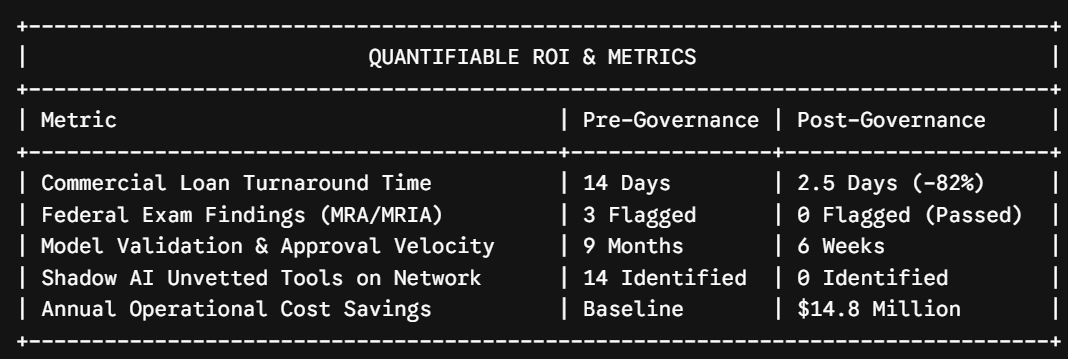
  • Core Message: Formal governance delivered a 100% compliant regulatory audit while dramatically improving operational velocity.
  • Key Content:
Metric Pre-Governance Post-Governance Impact / Improvement
Commercial Loan Turnaround 14 Days 2.5 Days 82% Acceleration
Federal Exam Findings (MRA/MRIA) 3 Flagged 0 Flagged Clean Regulatory Exam
Model Validation Velocity 9 Months 6 Weeks 83% Reduction in TTM
Shadow AI Tool Usage 14 Unvetted Tools 0 Unvetted Tools Complete Risk Mitigation
Annualized Operational Savings Baseline $14.8 Million Direct Bottom-Line Return

Slide 5: Strategic Lessons for a US Regional Bank

  • Core Message: Governance is an enabler of speed and trust, not a bottleneck to innovation.
  • Key Content:
    • Leverage Existing Standards: Building upon SR 11-7 and NIST AI RMF accelerates deployment cycles while maintaining regulatory alignment.
    • Prioritize Explainability Over Complexity: In regulated credit workflows, transparent, auditable models beat black-box architectures every time.
    • Clear Governance Accelerates Growth: Automated validation pipelines reduced model time-to-market from 9 months to 6 weeks, positioning First Lakes as a premier mid-market lender in the Midwest.

Governance Frameworks for Enterprise AI: Regional Bank Case Study

Note: This a composite case study, based on our observation and analysis of multiple regional banks. The names and numbers in this case study are hypothetical, and but the lessons are real.

  • Organization: First Lakes Financial Bancorp
  • Headquarters: Chicago, Illinois
  • Asset Size: $42 Billion AUM (Operating 120 branches across Illinois, Indiana, and Wisconsin)

Background & Operational Context

First Lakes Financial Bancorp, a regional bank headquartered in Chicago, built its reputation on commercial real estate lending, mid-market business banking, and personalized wealth management. Facing margin pressures from national tier-one banks and digital-first fintechs, executive leadership launched a strategic initiative to deploy enterprise-grade AI applications to streamline credit underwriting, automate regulatory anti-money laundering (AML) monitoring, and launch an AI-driven commercial client advisory assistant.

However, as a regional institution regulated by the Federal Reserve, the FDIC, and the OCC (Office of the Comptroller of the Currency), First Lakes faced strict regulatory scrutiny under US banking guidelines—specifically OCC Bulletin 2011-12 / Federal Reserve SR Letter 11-7 on Model Risk Management.

The Pre-Governance Challenge

Prior to adopting a formal AI governance framework, First Lakes experienced significant operational and regulatory friction:

  • Fragmented Shadow AI Deployments: Multiple commercial lending units independently adopted unvetted third-party credit scoring tools, creating unmapped algorithmic risks and data lineage gaps across regional offices.

  • Regulatory Pushback: During a periodic examination, federal regulators flagged an experimental machine-learning credit scoring model for lacking clear explainability, questioning whether the model complied with the Fair Credit Reporting Act (FCRA) and the Equal Credit Opportunity Act (ECOA).

  • Data Silos and PII Risks: Customer transaction data from legacy core banking databases was being manually exported by analytics teams to fine-tune open-source models, raising acute risks around Personally Identifiable Information (PII) leakage.

Implementation of the AI Governance Framework

To address these vulnerabilities, the Board of Directors established the Enterprise AI Steering & Model Governance Council, chaired by the Chief Risk Officer (CRO) and Chief Information Officer (CIO), with active participation from Legal, Information Security, and Commercial Banking heads.

First Lakes deployed a four-phase governance architecture tailored to US regional banking regulations over a 12-month period.

==========================================
FIRST LAKES BANK AI GOVERNANCE ARCHITECTURE
==========================================
1. STRATEGIC RISK TIERING (SR 26, SR 11-7, and ECOA Alignment)
2. EXPLAINABLE MLOPS (SHAP & Counterfactuals)
3. DATA & OPA (WORM Logging & PII)
4. HUMAN-IN-THE-LOOP CHECKPOINTS (Automated Escalation & Circuit Breakers)
==========================================

Phase 1: Strategic Risk Tiering & Model Inventory

Aligned with SR 11-7 guidelines and global risk frameworks (such as NIST AI RMF), First Lakes cataloged every analytical asset into a centralized model inventory and instituted a four-tier risk classification:

  • Tier 1 (High Risk / Regulatory Sensitive): Commercial & Consumer Credit Underwriting Models, Automated AML/BSA Transaction Monitoring, and AI-driven Fair Lending Assessments.

  • Tier 2 (Moderate Risk): Commercial Client Advisory Assistant, Liquidity & Deposit Forecasting Models.

  • Tier 3 (Low Risk): Internal IT Helpdesk Automation, Automated Document Summarization for Wealth Managers.

Phase 2: Explainable AI (XAI) for Fair Lending Compliance

To satisfy ECOA requirements, the bank mandated that no credit model could operate as a “black box.”

  • Engineering teams integrated SHAP (SHapley Additive exPlanations) and counterfactual reasoning algorithms into the credit evaluation engine.

  • For every adverse credit decision (e.g., loan denial or rate increase), the system automatically generated specific, rank-ordered Adverse Action Reason Codes (such as high debt-to-income ratio or insufficient liquidity history) required by federal lending laws.

Phase 3: Technical Guardrails & Data Provenance

  • Policy-as-Code Enforcement: Using Open Policy Agent (OPA) integrated at the API gateway layer, First Lakes blocked any unauthorized outbound API calls containing sensitive customer PII or account numbers.

  • WORM Audit Trails: All model inputs, retrieved context blocks from internal vector databases, and model outputs were immutably recorded in Write-Once-Read-Many (WORM) cloud repositories, creating an audit-ready log for federal bank examiners.

Phase 4: Human-in-the-Loop (HITL) Execution Rules

To balance speed with regulatory compliance, First Lakes established strict operational execution boundaries:

  • Automated Approval Ceiling: The credit AI was permitted to auto-approve small business credit lines up to $250K only if the model’s confidence score exceeded 92% and zero demographic variance anomalies were detected.

  • Mandatory Human Escalation: Any credit decision between $250K and $2M, or any applicant file triggering a confidence score below 92%, was automatically routed to a senior human credit officer alongside an explainability report.

Measurable Results & Regulatory Outcomes

By embedding formal governance directly into its technology stack and organizational culture, First Lakes Financial Bancorp achieved significant operational and business milestones within 12 months:

  • Clean Regulatory Audit: During the subsequent examination cycle, federal regulators commended First Lakes’ Model Risk Management framework as a best-practice implementation of SR 11-7 for artificial intelligence.

  • Operational Efficiency: Commercial loan decisioning speed increased by 82%, allowing the regional bank to effectively compete with national money-center banks for mid-market Chicago commercial accounts.

  • Demographic Fairness Verification: Quarterly algorithmic audits confirmed zero statistically significant disparity impact across loan applicants in primary markets (Chicago metro, Milwaukee, and Rockford).

Key Takeaways for US Regional Banks

  1. Leverage Existing Frameworks: US regional banks do not need to reinvent model management; mapping AI governance directly to existing SR 11-7 and NIST AI RMF standards satisfies regulators while accelerating safe adoption.

  2. Explainability Over Absolute Complexity: In credit and underwriting workflows, a slightly simpler, highly explainable model paired with SHAP diagnostic tools beats a complex black-box architecture that fails regulatory scrutiny.

  3. Governance Accelerates Velocity: Rather than delaying innovation, establishing clear risk tiers and automated CI/CD validation pipelines reduced First Lakes’ time-to-market for validated models from months to weeks.

Next: Please see the AI Governance Executive Presentation Outline.

Case Study: AI Governance Implementation in a Regional Bank -Executive Presentation

Tier 1 AI Risk Assessment Checklist for US Regional Banks

Tailored for evaluating High-Risk (Tier 1) artificial intelligence assets—specifically Credit Underwriting and Anti-Money Laundering (AML) / Bank Secrecy Act (BSA) transaction monitoring models—in accordance with Federal Reserve SR 11-7 / OCC Bulletin 2011-12 guidelines and the NIST AI Risk Management Framework.

1. Governance & Regulatory Alignment

  • [ ] SR 11-7 Model Inventory Registration: Ensure the candidate model is formally cataloged in the Enterprise Model Inventory with an assigned Model Owner, Risk Rating (Tier 1), and scheduled validation cadence.

  • [ ] Regulatory Scope Verification: Confirm model alignment with relevant federal mandates:

    • Credit Models: Equal Credit Opportunity Act (ECOA / Regulation B), Fair Credit Reporting Act (FCRA), and Fair Lending laws.

    • AML/BSA Models: FinCEN regulatory thresholds, USA PATRIOT Act compliance, and Suspicious Activity Report (SAR) filing triggers.

  • [ ] Model Governance Council Sign-off: Secure formal pre-deployment review approval from the Joint Model Risk Management (MRM) and AI Ethics Steering Committee.

2. Data Integrity, Privacy & Lineage

  • [ ] Data Provenance & Lineage Mapping: Document the full lifecycle of training, validation, and production data streams, identifying all source databases and transformation pipelines.

  • [ ] PII & Protected Class Sanitization:

    • Verify that prohibited variables (e.g., race, gender, age, marital status, national origin) are excluded from credit training datasets.

    • Implement automated scanning at API gateways to prevent raw PII leakage to third-party endpoints or unauthorized vector stores.

  • [ ] Data Quality & Representativeness Audit: Evaluate training data for historical bias, missing values, sample selection bias, and geographical representation across regional operating territories.

3. Conceptual Soundness & Model Architecture

  • [ ] Theory & Methodology Documentation: Document the underlying algorithmic methodology (e.g., Gradient Boosted Trees, Neural Networks, Logistic Regression) and justify why the chosen approach is suitable for the business objective.

  • [ ] Explainability (XAI) Architecture:

    • Credit Models: Implement SHAP (SHapley Additive exPlanations) or Integrated Gradients to ensure every credit decision can generate rank-ordered Adverse Action Reason Codes required by ECOA.

    • AML Models: Ensure transaction anomaly flags map to interpretable behavioral metrics (e.g., sudden velocity changes, structured cash deposits) for SAR documentation.

  • [ ] Hyperparameter & Optimization Audit: Validate that model hyperparameter tuning routines were logged and audited to prevent overfitting on historical training data.

4. Model Validation, Testing & Bias Diagnostics

  • [ ] Out-of-Sample & Out-of-Time Testing: Conduct rigorous backtesting using historical data across varying economic cycles (e.g., rate fluctuation periods or regional credit stress).

  • [ ] Fair Lending & Disparate Impact Analysis:

    • Perform statistical tests (e.g., Marginal Effect Analysis, Adverse Impact Ratios) across protected demographic groups to confirm compliance with 80% rule thresholds.

    • Test alternative less discriminatory algorithms (LESS/ADA) if baseline models demonstrate statistically significant demographic variance.

  • [ ] AML Sensitivity & False Positive Testing: Benchmark AML model detection rates against baseline rules engine performance, auditing false-positive reduction ratios and false-negative leakages.

  • [ ] Robustness & Adversarial Stress Testing: Conduct sensitivity testing against corrupted, synthetic, or adversarial data inputs to measure model stability under unexpected data drift.

5. Operational Deployment & Human-in-the-Loop (HITL) Controls

  • [ ] Policy-as-Code & Boundary Enforcement: Program dynamic business rules into execution gateways (e.g., setting hard credit line caps or minimum credit score thresholds independent of model output).

  • [ ] Human Escalation Thresholds:

    • Credit Underwriting: Define clear dollar thresholds (e.g., automated execution restricted to loans $\le \$250,000$ with $\ge 92\%$ confidence score; mandatory human underwriter review for all higher exposure or lower confidence cases).

    • AML Monitoring: Require mandatory BSA Officer review before closing any system-flagged suspicious transaction alert.

  • [ ] Circuit Breakers & Rollback Triggers: Implement automated kill-switches to halt automated execution if real-time error rates, drift thresholds, or system latencies breach predefined limits.

6. Continuous Monitoring & Audit Readiness

  • [ ] Data & Conceptual Drift Tracking: Deploy real-time telemetry to continuously monitor Population Stability Index (PSI) and Characteristic Stability Index (CSI) for input features.

  • [ ] Immutable Audit Logging (WORM Storage): Record all model queries, feature inputs, confidence scores, and outputs in Write-Once-Read-Many storage environments to ensure full auditability during federal regulatory examinations.

  • [ ] Periodic Re-Validation Schedule: Establish an automated trigger for comprehensive annual re-validation or emergency re-validation upon significant economic shocks or regulatory updates.

Model Validation Report (SR 11-7 / OCC 2011-12)

Model Validation Report
(SR 11-7 / OCC 2011-12)

Model Name: Commercial & Consumer Automated AI Credit Underwriting System (CAICUS)
Model Owner: Commercial & Consumer Credit Risk Division
Validator / Reviewer: Model Risk Management (MRM) Independent Validation Team
Model Risk Tier: Tier 1 (High Risk / Regulatory Sensitive)
Validation Date: September 2026

1. Executive Summary & Validation Verdict

1.1 Scope of Review

The Independent Model Risk Management (MRM) group conducted a full initial validation of the Commercial & Consumer Automated AI Credit Underwriting System (CAICUS) v2.4. This evaluation assesses compliance with Federal Reserve SR 11-7 / OCC Bulletin 2011-12, Equal Credit Opportunity Act (ECOA / Regulation B), Fair Credit Reporting Act (FCRA), and NIST AI RMF standards.

1.2 Overall Validation Rating

  • Verdict: Approved with Conditions
  • Risk Level: Tier 1 (High)
  • Re-validation Frequency: Annual (Next Scheduled: Q3 2027)

1.3 Key Findings & Mandatory Remediation Items (MRA/MRIA)

  • MRIA 2026-01 (High): Explainability Baseline: SHAP value calculations for commercial real estate exposure lack automated integration with legacy core system Adverse Action code generators. Remediation Due: 60 Days.
  • MRA 2026-02 (Medium): Data Stability Tracking: Population Stability Index (PSI) alert thresholds are set manually rather than dynamically updating across changing interest rate regimes. Remediation Due: 90 Days.

2. Model Overview & Business Context

Component Description
Business Purpose Automated underwriting, risk-based pricing, and credit line determination for small-to-mid enterprise (SME) and consumer loan applicants up to $250,000.
Model Architecture Gradient Boosted Decision Trees (XGBoost) combined with dynamic SHAP (SHapley Additive exPlanations) explainability layers.
Key Inputs Bureau credit scores, debt-to-income (DTI) ratios, liquidity history, 24-month transaction velocity, and verified business revenue.
Key Outputs Approved/Denied recommendation, recommended credit ceiling, risk tier score (1–10), and top 4 adverse factors (if denied).

3. Data Integrity, Lineage & Governance Audit

3.1 Data Lineage & Sanitization

  • Data Sources: Core banking transactional database, credit bureau API feeds, audited financial statements.
  • Prohibited Variables Verification: Confirmed total exclusion of protected class attributes (race, gender, age, marital status, national origin) and direct proxies in both training and operational feature stores.
  • Privacy Controls: Evaluated Open Policy Agent (OPA) integration at the API gateway layer to ensure customer PII is masked prior to model feature extraction.

3.2 Data Quality & Representativeness

  • Evaluated dataset completeness across primary operating territories (Midwest US regional foot-print).
  • Verified that historical loan performance data spans both expansionary and contractionary credit cycles (2018–2025 data range).

4. Conceptual Soundness & Algorithmic Design

4.1 Theoretical Justification

  • The selection of XGBoost over traditional logistic regression is justified by a 14% improvement in Gini coefficient performance on non-linear commercial relationship datasets.
  • Hyperparameter tuning frameworks were audited to ensure grid searches were constrained against overfitting on edge-case regional data.

4.2 Explainability (XAI) & Fair Lending Architecture

  • ECOA Reason Code Generation: The model utilizes global and local SHAP value rankings to extract the top four negative feature contributions for every adverse credit decision.
  • Audit Findings: Explainability pipelines operate accurately for consumer lending features, but require minor feature-mapping alignment for specialized commercial real estate metrics (refer to MRIA 2026-01).

5. Model Performance, Backtesting & Bias Diagnostics

5.1 Discriminative Power & Calibration

  • Receiver Operating Characteristic (ROC-AUC): 0.865 (Target >= 0.80)
  • Kolmogorov-Smirnov (KS) Statistic: 54.2% (Target >=45%)
  • Brier Score (Calibration): 0.042 (Demonstrates strong alignment between predicted default probability and observed defaults).

5.2 Disparate Impact & Fair Lending Testing

MRM conducted independent demographic fairness tests across protected classes using synthetic proxy matching and Bayesian Improved Surname Geocoding (BISG):
Metric Target / Benchmark Observed Result Status
Adverse Impact Ratio (AIR) >= 0.80
(80% Rule)
0.92 Pass
Marginal Effect Variance < 0.05 across cohorts 0.02 Pass
Standardized Difference in Means < 0.25 0.08 Pass

6. Operational Controls, HITL & Monitoring

6.1 Human-in-the-Loop (HITL) Rules

  • Auto-Execution Limit: Restricted strictly to credit applications <= $250K where model confidence >= 92%
  • Mandatory Officer Routing: Applications between $250K and $2M, or applications triggering confidence scores < 92%, are automatically routed to senior credit underwriters alongside the SHAP diagnostic payload.

6.2 Monitoring & Fallback Safeguards

  • Drift Telemetry: Real-time monitoring of PSI (Population Stability Index) and CSI (Characteristic Stability Index) configured with alerts at PSI> 0.10 (warning) and PSI > 0.25 (mandatory model halt).
  • Audit Trail Verification: Confirmed all inputs, feature vectors, SHAP outputs, and execution decisions are logged to WORM (Write-Once-Read-Many) compliant cloud infrastructure for regulatory inspection.

7. Sign-off & Approval Matrix

Role Name / Title Signature Date
Lead Validator VP, Model Risk Management [Signed] Sept 14, 2026
Head of MRM SVP, Enterprise Model Governance [Signed] Sept 16, 2026
Chief Risk Officer Executive VP, Chief Risk Officer [Signed] Sept 18, 2026